
Social Media Image & Video Sizes: What Each Platform Actually Documents
Updated 3 August 2026
Short answer
Instagram accepts feed images between 4:5 and 1.91:1 at 320–1440px wide, and recommends 9:16 for Reels and Stories. TikTok recommends 9:16 video at 540×960 or larger. Pinterest recommends 2:3 Pins at 1000×1500. Almost every other number circulating in "social media size" charts — including Facebook's dimensions and vertical-video safe zones — is not published by the platforms themselves, so treat it as an estimate rather than a spec.
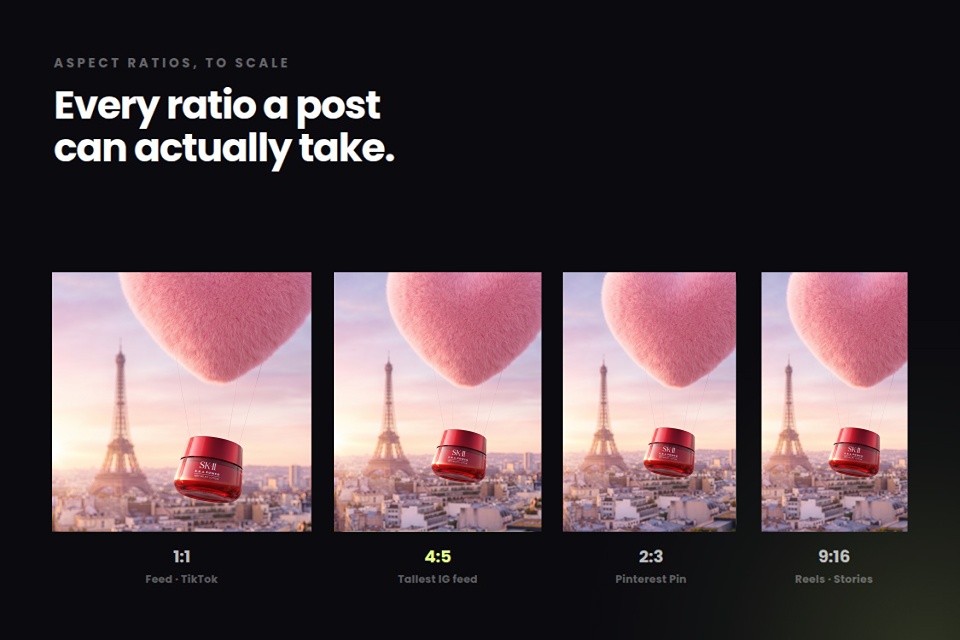
Why do social media size guides all disagree with each other?
Because most of them are copying each other rather than the platforms. Very few of the numbers in a typical "2026 social media image sizes" chart appear anywhere in official documentation. Some were accurate three years ago, some were inferred by measuring screenshots, and some appear to be guesses that got repeated until they looked authoritative.
This page is organised the other way round. Everything below is either taken from the platform's own developer or business documentation and linked at the bottom, or explicitly flagged as unverified. Where a platform simply does not publish a number, we say so instead of filling the gap — because a wrong spec costs you a cropped logo or an unreadable caption on every post you make.
What image and video sizes does Instagram support?
Instagram's own developer documentation is the most precise public source, and it defines feed images by aspect-ratio range rather than by fixed pixel sizes: anything between 4:5 (portrait) and 1.91:1 (landscape) is accepted, with an image width between 320 and 1440 pixels.
The practical consequence is that 4:5 is the tallest image Instagram will take without cropping — which also makes it the ratio that occupies the most vertical space in the feed. 1080 × 1350 is the standard way to hit that.
You may have read that Instagram now wants 3:4 for the feed. Be careful with that advice: 3:4 is taller than 4:5, and Instagram's documented range does not accept it. We could not find official confirmation of a 3:4 feed format, and the API contradicts it, so we would not design a whole content library around it yet.
- Feed images
- Aspect ratio between 4:5 and 1.91:1. Width 320–1440px. Use 1080 × 1350 (4:5) for maximum feed height.
- Reels
- 9:16 recommended. Maximum 1920px on the horizontal edge. Between 3 seconds and 15 minutes.
- Stories
- 9:16 recommended to avoid cropping or blank bars. Maximum 1920px horizontal. Between 3 and 60 seconds.
- Square (1:1)
- Well inside the accepted range and the safest single ratio if one asset has to work everywhere.
What are TikTok's video and photo specifications?
TikTok publishes precise specs for advertising formats and much less for organic posting, so the figures below come from its ads documentation. They describe what the platform accepts, which is the part that matters when you are producing an asset.
Note that TikTok publishes minimums, not recommendations, for resolution. The 1080 × 1920 figure you see everywhere is not a TikTok number — it is a sensible convention (it is simply 9:16 at 1080p), but it is not something TikTok documents.
- Vertical video
- 9:16, at least 540 × 960px. This is the recommended orientation.
- Horizontal video
- 16:9, at least 960 × 540px.
- Square video
- 1:1, at least 640 × 640px.
- File limits
- MP4, MOV, MPEG, 3GP or AVI. Up to 500MB. Bitrate 516 kbps or higher.
- Photo posts
- Up to 35 images per post. JPG/JPEG or PNG. Carousel resolutions offered: 1200 × 628, 640 × 640, and 720 × 1280.
What size should a Pinterest Pin be?
Pinterest is the most straightforward of the three, and the only one that states a single recommended pixel size outright in its creative guidance.
Worth knowing: Pinterest describes taller ratios as liable to be cut off in the feed, not as penalised. There is no claim anywhere in Pinterest's guidance that an unusual ratio is downranked — the risk is purely that your image gets cropped where you did not intend.
- Standard Pin
- 2:3 aspect ratio, or 1000 × 1500px.
- Other ratios
- Accepted, but taller images may be cut off in the feed.
- File
- PNG or JPEG. Up to 20MB on desktop, 32MB in-app.
- Text
- Title up to 100 characters, of which roughly the first 40 are most visible. Description up to 500 characters.
What about Facebook?
We are not listing Facebook dimensions here, because we could not verify a single one against Meta's own documentation — its business help pages are not machine-readable, and every figure in circulation traces back to third-party blogs rather than to Meta.
That is not the same as saying those numbers are wrong. It means we cannot stand behind them, and neither should any guide that presents them as official without having checked. Meta's Business Help Center is the source of truth; it is linked at the bottom of this page.
In practice, an asset built to Instagram's feed range will behave sensibly on Facebook, since both run on Meta's ad infrastructure and share aspect-ratio handling.
Where do platform buttons cover your vertical video?
This is the most useful question in short-form video and the worst documented. Captions, the username, the sound label, and the action buttons all sit on top of your frame, and none of TikTok, Instagram or YouTube publishes numeric safe-zone margins.
Third-party safe-zone charts exist, but they disagree materially. Two widely-shared 2025–2026 guides differ by 160 pixels on TikTok's bottom margin alone — around 15% of the frame height. Neither explains how it measured. Averaging them would produce a number with no basis at all.
So treat the following as a conservative estimate rather than a spec: on a 1080 × 1920 frame, keep anything that must stay readable — product name, price, call to action — inside roughly the central 900 × 1200 area, leaving about 20% clear at the top and 25% at the bottom. If you need precision, TikTok distributes downloadable safe-zone template files, and measuring those directly is the only reliable method available.
- Conservative text area
- Roughly the central 900 × 1200px of a 1080 × 1920 frame. An estimate, not an official spec.
- Top of frame
- Leave around 20% clear. Varies by platform and by whether the post carries extra formats.
- Bottom of frame
- Leave around 25% clear. This is where captions and action buttons stack up, and where third-party guides disagree most.
- Product placement
- Keep the product itself near the centre. It is the one element you cannot afford to have a button sitting on.
Which ratio should you generate if you only make one asset?
If the asset has to be posted in more than one place, 1:1 is the safest single choice: it sits comfortably inside Instagram's accepted feed range, is an accepted TikTok video ratio, and crops predictably almost everywhere else.
If you can produce two, make the second one 9:16. Between them, a square and a vertical cover the feed and the full-screen surfaces on every platform on this page, which is most of what a small brand actually needs.
Generating each format separately beats cropping one master asset. A crop moves your product off the composition it was staged for; regenerating keeps the product framed correctly for the shape it will actually be seen in.
Questions
Is 1080 × 1080 still the right size for an Instagram post?
It is well within Instagram's documented range and will not be rejected or degraded. Instagram accepts image widths from 320 to 1440 pixels, so 1080 is comfortably supported — but 1080 × 1350 (4:5) takes up more vertical space in the feed, which is usually worth more than the extra width.
Does Instagram now want 3:4 images?
We could not verify this against any official Instagram or Meta documentation, and Instagram's own published aspect-ratio range for feed images stops at 4:5 — which is less tall than 3:4. Until Instagram documents it, 4:5 is the safer target for a portrait feed post.
What resolution should I use for TikTok?
TikTok documents a minimum of 540 × 960 for vertical video, not a recommended resolution. The commonly cited 1080 × 1920 is simply 9:16 at 1080p and is a reasonable choice, but it is a convention rather than a TikTok specification.
Will an unusual aspect ratio hurt my reach?
None of the platforms covered here documents a ranking penalty for aspect ratio. What they do document is cropping: Pinterest states that taller Pins may be cut off in the feed, and Instagram simply will not accept images outside its range. The real cost is visual, not algorithmic.
Should I crop one image into every size, or generate each one?
Generate each one where you can. Cropping shifts the product away from the composition it was framed for, and a product that sat centred in a square can end up cut off or awkwardly placed in a 9:16 crop. Producing the asset directly in its target ratio keeps the staging intact.
Make it with Glowya
Sources
- Instagram Platform — IG User Media reference (Meta for Developers)
- Instagram Help Centre — photo resolution
- TikTok — video ad specifications
- TikTok — carousel ad specifications
- TikTok Support — making a photo post
- Pinterest — creative best practices
- Meta Business Help Centre (for Facebook specs we could not verify)